|
24-25 nov. 2025 Grenoble (France)
|
|
|
|
Programme
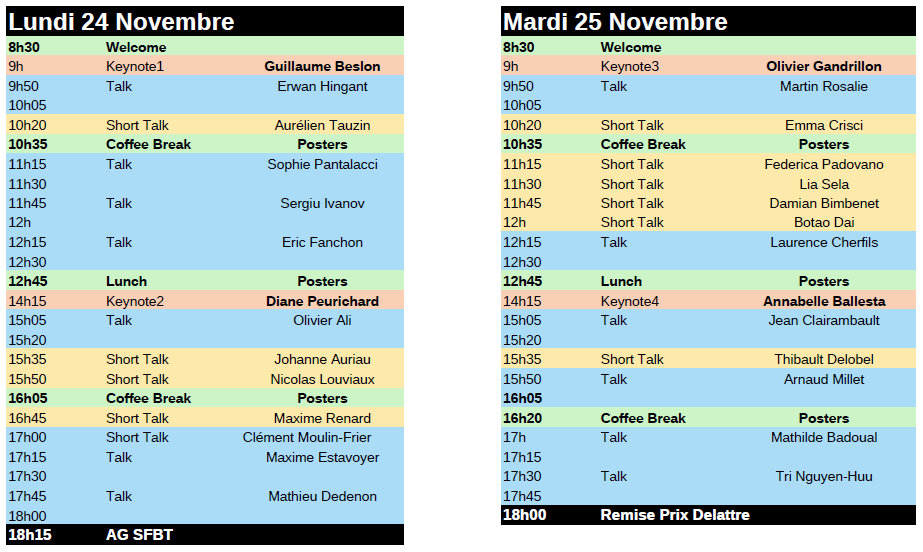
Lundi 24 Novembre
Matin : Session Adaptation / Evolution
Keynote : Guillaume Beslon (INSA Lyon)
Strucural mutations set an equilibrium non-coding genome fractions
The fraction of coding vs non-coding DNA is highly variable across the Tree of Life. Despite decades of debate, its determinants are still unknown. While some parts of the non-coding DNA arguably have a regulatory function, a large part does not seem to have a detectable impact on any phenotypic trait, the so-called Junk DNA. As such, the abundance of non-functional DNA in the vast majority of genomes throughout the Tree of Life challenges purely adaptationist explanations. Historically, the debate on the evolutionary determinants of non-coding sequences has focused mainly on the question of selection, drift, and the balance between the two. But while these two forces are undoubtedly at the heart of evolution, evolution also requires a third force: variation. Indeed, one can state with absolute certainty that the genome architecture, and specifically the amount of non-coding sequences in a genome, can only vary through mutational events, including chromosomal rearrangements and small indels. Yet, the precise way these different types of mutations interact with the genome architecture has never been investigated in detail.
Starting from this very simple idea, we propose a mathematical model of the evolution of non-coding sequences. Assuming that the genome is partitioned into neutral and selected segments, we modeled various types of mutations susceptible to change the amount of non-coding sequences (typically chromosomal rearrangements and indels). By computing the probability for these events to be neutral or deleterious, we show that the non-coding fraction of the genome is shaped by two factors: unavoidable biases in the neutrality of the different mutation types (adding base pairs is more likely to be neutral than removing some), and strong robustness constraints imposed by the mere existence of chromosomal rearrangements. Indeed, rearrangements are more frequent and, on average, larger in larger genomes, imposing a strong second-order selection on genome size. We show that these two factors ensure the existence of an equilibrium non-coding fraction, which depends solely on the product of population size and mutation rate. Hence, by playing on these two factors – and on their product – the model is able to reproduce the full diversity of genomic architectures, from prokaryotes, for which it predicts a dense genome with a low, tightly constrained fraction of junk-DNA, to multicellular eukaryotes for which it predicts the accumulation of a substantial fraction of junk-DNA.
Reference: Luiselli, J., Banse, P., Mazet, O., Lartillot, N. and Beslon, G. (2025). Structural mutations set an equilibrium non-coding genome fraction. bioRxiv, 2025-02.
Après-midi : Session Emergence / Morphogenèse
Keynote : Diane Peurichard (Inria)
Mathematical modeling of tissue morphogenesis and regeneration
In this talk, we investigate the mechanisms by which organs acquire their functional structure and rebuild their architecture after injury. We do this by the development of Individual Based Models (IBM) confronted to experimental data. We first propose and study a simple model for architecture emergence, featuring cells (2D spheres) appearing and growing in a dynamical network of cross-linked fibers (connected segments). Cells and fibers are supposed to interact via mechanical repulsion interactions. When applied to adipose tissues, the model produces structures that compare quantitatively well to the experimental observations and seems to indicate that cell clusters could spontaneously emerge as a result of simple mechanical interactions between cells and fibers. By suggesting that vasculature could be secondary to tissue architecture emergence, this simple model therefore proposes a new view of tissue development. In the second part of the talk, we extend the model to account for mechanisms of tissue repair after injury, and use it to explore the mechanisms responsible for adipose tissue regeneration. The model successfully generates regeneration or scar formation as functions of few key parameters, and indicates that the fate of injury outcome could be mainly due to extra-cellular (ECM) matrix rigidity. Via a combined in-vivo / in-silico approach, the model enables to identify a new in-vivo validated therapeutic target, enabling to induce regeneration in mouse adipose tissues. Altogether, these studies point to the essential role of mechanics in tissue structuring and regeneration, and bring a comprehensive view on the role of ECM crosslinking on tissue architecture emergence and reconstruction.
Mardi 25 Novembre
Matin : Session Biologique Théorique - Enjeux et perspectives
Keynote: Olivier Gandrillon (ENS de Lyon)
Multiscale modeling of the spatial structure of cancer stem cells in tumoroids derived from neuroblastoma patients
I will present the use of an original muliagent multiscale modelling approach to try to capture the specific spatial positioning of cancer stem cells with neuroblastomas patient-derived tumoroids (PDTs)—3D ex vivo structures mimicking the original tumor.
I will demonstrates the critical role of spatial stem-to-stem cell short-range signaling in PDTs organization and highlights the value of a multiscale approach to identify the minimal mechanisms required for their formation.
Après-midi : Session Cancer et Résistance
Keynote : Annabelle Ballesta (Institut Curie)
Systems pharmacology and machine learning for optimizing treatments of brain tumors
Glioblastoma (GBM), the most frequent and aggressive brain tumor in adults, is associated with a dismal prognostic despite intensive treatment involving surgery, radiotherapy and temozolomide (TMZ)-based chemotherapy. The initial or acquired resistance of GBM to TMZ appeals for precision medicine approaches for the design of novel efficient combination pharmacotherapies. To that end, a comprehensive approach combining quantitative systems pharmacology (QSP) and machine learning was undertaken to design TMZ-based drug combinations circumventing the initial resistance to the alkylating agent. A QSP model representing TMZ cellular pharmacokinetics-pharmacodynamics and dysregulated pathways in GBM based on ordinary differential equations was developed and validated using multi-type time- and dose-resolved datasets. In silico drug screening based on numerical optimization and subsequent experimental validation identified a strategy to re-sensitize TMZ-resistant cells consisting in combining TMZ with inhibitors of the base excision repair and of homologous recombination. Using machine learning, model parameters driving response to such optimal multi-agent therapy were derived to assist decision making in patients. Thus, we successfully demonstrated the relevance of combined QSP and machine learning to design efficient drug combinations re-sensitizing glioblastoma cells initially resistant to TMZ. The developed framework may further serve to identify personalized therapies and administration schedules by extending it to account for additional patient-specific altered pathways and whole-body features.
Clôture et remise du Prix Pierre Delattre à 18h.